

CURRENT CAMPAIGN INITIATIVES
Welcome to our Campaign Initiatives page, where shine a spotlight on various initiatives from around the world dedicated to combatting hostile architecture. While these campaigns are not our own, they represent the collective effort of individuals and organisations striving to create more inclusive urban environments. Thus, by showcasing these diverse initiatives, we aim to demonstrate that we are not alone in our commitment to addressing the challenge of homelessness and exclusionary design practices.

"ARCHISUITS" PROJECT
The Archisuits project, led by artist and activist Sarah Ross in 2005-2006, emerged as a campaign imitative aimed at confronting the injustice embedded within hostile architecture (Insecure Spaces, n.d.). Specifically, Ross ingeniously designed wearable wearable suits constructed from brightly coloured foam, strategically mimicking the shapes and forms of hostile architectural elements such as spikes and dividers (Insecure Spaces, n.d.). Thus, these suits served as both a provocative artistic statement and a practical tool for raising awareness about the dehumanising impact of hostile design on the homeless population (Insecure Spaces, n.d.). Ultimately, the Archisuits challenged societal perceptions and sparked critical conversations about the inherent injustice of prioritising aesthetics over human dignity in public spaces, effectively amplifying the voices of marginalised communities and necessitating the need for more inclusive urban design solutions.
01
"DESIGN CRIME" STICKERS
Stuart Semple's "Design Crime" stickers initiative stands as a powerful campaign initiative against hostile architecture, addressing it as a form of housing injustice (Semple, 2018). In 2018, Semple's discovery of hostile architecture of the hostile-designed public benches - led to the launching of petitions calling for the removal of these armrests, which garnered over 20,000 signatures and compelled the local government to take action (Brennecke, 2023). However, Semple's efforts didn't stop there as through his Hostile Design Website, he curated images of hostile designs from around the world and created stickers bearing the words "Design Crimes" (Brennecke, 2023; Semple, 2018). Thus, these stickers serve as a means for individuals to raise awareness and advocate for more inclusive urban design, by affixing these stickers to hostile architecture and sharing photos on social media using the hashtag #HostileDesign. This way participants contribute to a global database documenting instances of hostile architecture and ultimately strive to dismantle this unjust practice and foster more inclusive public spaces (Semple, 2018).
02

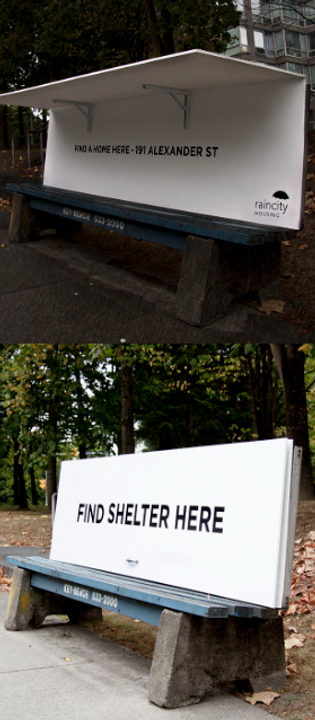
"OUR BENCH" CAMPAIGN
The "Our Bench" campaign by Raincity Housing is an example of a compelling campaign initiative in the fight against hostile architecture, addressing housing injustice within our urban environment (Raincity Housing, 2014). Developed by an organisation based in Vancouver dedicated to tackling homelessness and housing issues, this innovative project offers practical support to those in need (Brennecke, 2023). Raincity Housing's self-designed bench serves as a temporary shelter for individuals without permanent housing, through unfolding its backrest into a roof during rainy weather or for enhanced psychological safety (Brennecke, 2023; (Lus, 2014). Additionally, the message inscribed on the backrest boldly asserts the bench's purpose as a potential bedroom for the vulnerable, shedding light on the harsh reality that a simple bench can serve as a lifeline for someone experiencing homelessness (Lus, 2014).
03